
Loading...
Serving Manteca, CA and surrounding areas. (209) 880-7645
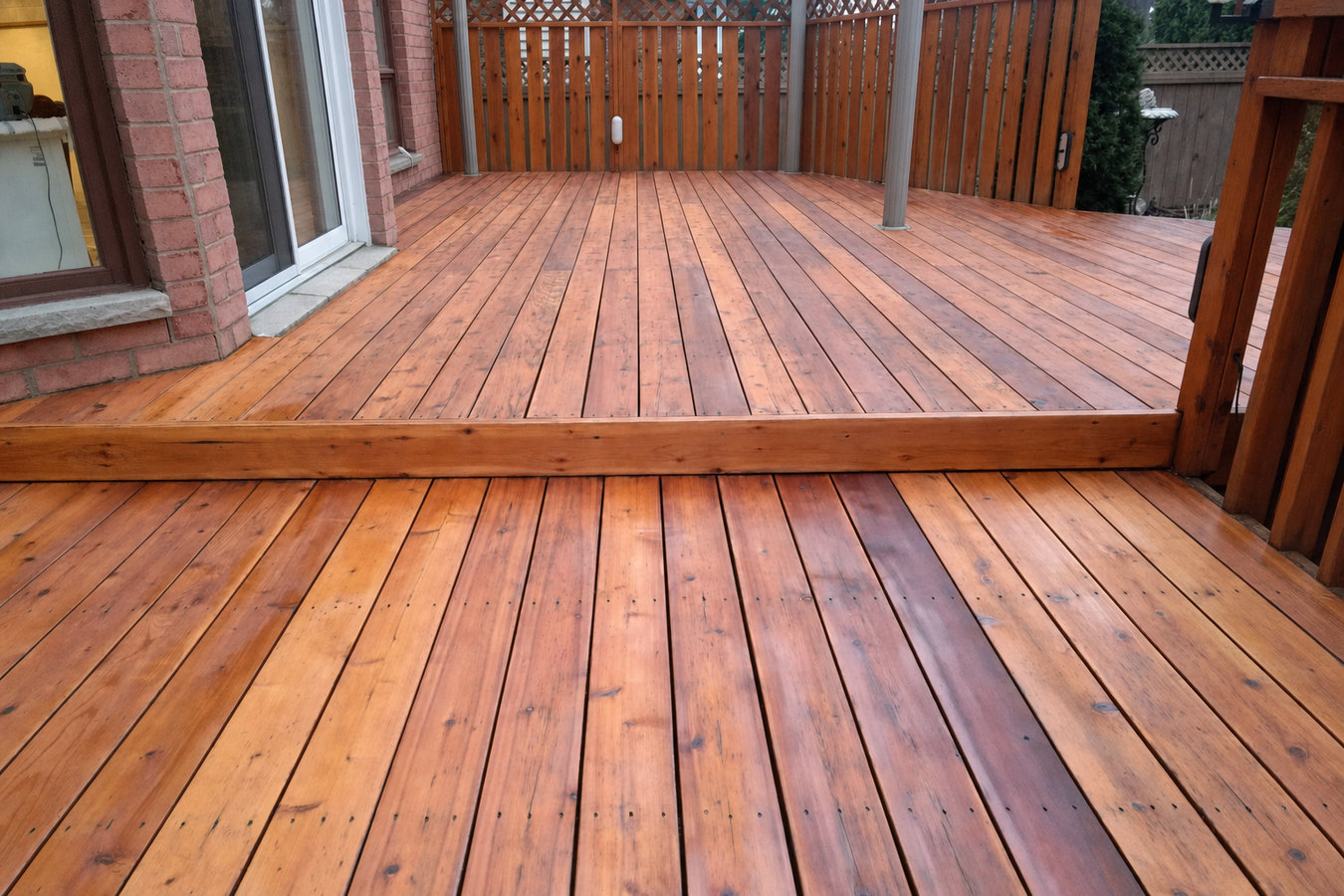
Manteca Deck & Fence is a deck builder serving Riverbank, CA with deck staining and sealing, composite and cedar deck construction, wood and vinyl fence installation, covered patio covers, and pergola builds - all designed for the Stanislaus River corridor's clay soil, hot summers, and tule fog winters. We have served Central Valley homeowners since 2020 and reply within one business day.
Riverbank decks take a beating from both ends of the calendar - summer UV above 100 degrees cracks and dries out any sealant that has aged past its service window, and winter tule fog keeps the surface damp for weeks at a time once the sealant fails. Staying on a one-to-two year restaining schedule is the most cost-effective way to protect a wood deck in this climate. Our deck staining and sealing service covers prep, surface cleaning, light sanding where needed, and a penetrating sealant or stain coat matched to your decking material and how you plan to use the space.
Riverbank homeowners who are tired of the annual sealing cycle and watching their deck surface degrade between maintenance visits are good candidates for composite decking. Composite boards do not absorb the fog moisture that damages bare wood, do not crack from sustained summer UV, and do not require any sealing schedule after installation. For a Riverbank homeowner planning to stay put for fifteen or more years, the upfront cost difference compared to wood typically comes back through eliminated maintenance and a surface that looks the same at year ten as it did at year one.
Riverbank's newer tract developments on the south and east sides of the city - built mostly from the 1990s onward - tend to have vinyl fencing that handles the valley's seasonal extremes without painting, staining, or board replacement. For homeowners who commute to Modesto or beyond for work and are not around during the week to deal with exterior maintenance, vinyl is a practical long-term answer. It does not rot, does not require painting, and holds its appearance through the wet-dry cycle that causes wood fences to cup and split over time.
The older neighborhoods near downtown Riverbank - along Santa Fe Avenue and the streets branching off it - have homes that sit on modest lots where a wood privacy fence defines the yard and gives families real outdoor space. The most important installation detail in Riverbank is footing depth: the clay soil throughout this area shifts enough between wet winters and dry summers to tip posts that were not set into stable ground below the active clay zone. A fence that leans at year three almost always had footings that were too shallow or skipped concrete entirely.
Riverbank summers make an uncovered patio impractical during the hottest part of the day from June through September. A solid-roof patio cover changes when the space is usable - afternoon heat that keeps you inside without shade becomes manageable once overhead structure blocks the direct sun and radiant load. Riverbank lots in the established neighborhoods are modest in size, so a cover attached directly to the house often works better than a freestanding structure, and the attachment needs to be properly anchored into the house framing rather than into stucco only.
Older Riverbank homes - particularly those built in the 1950s through the 1970s near the downtown core - often have the lot dimensions and backyard orientation that suit a cedar deck addition well. Cedar handles the Central Valley climate better than lower-grade pressure-treated pine: its natural oils resist the fog moisture that seeps into less protected softwoods in winter, and it holds penetrating sealants better between maintenance cycles. For Riverbank homeowners who want real wood for the appearance and the feel underfoot, cedar is the right choice.
Riverbank has a housing mix that spans almost a century of construction. The older homes near downtown Santa Fe Avenue were built from the 1940s through the 1970s, while newer tract development on the south and east edges of the city continued through the 2010s. The two groups have different structural characteristics, different attachment points for ledger-connected decks, and different maintenance histories. A contractor who does not recognize the difference ends up treating a 1960s wood-frame ranch home the same as a 2005 stucco-sided tract home - and the ledger attachment, flashing, and footing design should not be the same.
The Central Valley clay soil throughout Riverbank is the single factor that causes the most outdoor structure failures in this area. Clay absorbs winter rain slowly and swells, then dries and shrinks during the long dry season from May through October. That cycle repeats every year and applies both lateral pressure and vertical movement to anything set into the ground. Fence posts set without adequate depth and concrete footings in stable soil below the shrink-swell zone begin to lean within two to three seasons. Deck footings that sit within the active clay layer slowly rack the framing above. This is not an unusual condition in Riverbank - it is the standard, and the city's Building Department requires permits for deck work in part because inspections catch footing-depth problems before they are buried.
The seasonal climate in Riverbank adds to the challenge. Summer temperatures regularly climb above 100 degrees Fahrenheit from June through September, placing sustained UV and thermal stress on any exterior material. Wood decking that enters summer without a fresh sealant coat begins to check and dry out within weeks of the first heat wave. Sealants applied too thin or too infrequently fail before the season is out, leaving the wood unprotected for the months that do the most damage.
The wet season brings a different problem. Riverbank gets most of its annual rainfall - roughly 12 to 14 inches - during the winter months, and tule fog keeps exterior surfaces persistently damp from December into February. Wood that was already weakened by summer UV absorbs that moisture readily, which accelerates surface checking, cupping, and the beginnings of rot in framing members that were not pressure-treated to the correct rating. Properties near the Stanislaus River on Riverbank's north side sit on lower ground that can stay wetter for longer after rain, which makes the moisture issue more pronounced in those neighborhoods. The right material choices and a consistent sealing schedule address both ends of the weather cycle. According to the National Weather Service Hanford office, tule fog episodes in this region can last for days or weeks at a stretch - long enough to saturate exposed wood surfaces thoroughly.
Our crew works throughout Riverbank regularly, and we understand the local conditions that affect deck builder work here. Riverbank sits just east of Modesto along State Route 108 and State Route 120, close enough to the larger city that many residents commute there for work but far enough to maintain its own identity and its own city services. Permit applications go through the Riverbank Community Development Department, and we know the process well enough to submit complete applications that do not require correction letters before approval.
The city is named for its location on the south bank of the Stanislaus River, which forms the northern boundary of town and is a recognizable landmark for every Riverbank resident. The older downtown area along Santa Fe Avenue was established when Riverbank was a railroad town, and the homes in that corridor reflect the construction styles of the mid-twentieth century. The annual Riverbank Cheese and Wine Exposition is one of the most well-known events in Stanislaus County and draws thousands of visitors to town each fall. Most homeowners here chose Riverbank because it is smaller and more residential than Modesto, and they expect a local contractor to know their neighborhood rather than treating it as just another stop on a long route.
We serve communities throughout the region, including Ripon to the north and Oakdale to the east. If you are in Riverbank or nearby, we can schedule a no-charge on-site estimate within our standard window.
Contact us at (209) 880-7645 or through our online form. We respond to every inquiry within one business day and get you on the calendar for an on-site visit, no waiting around for a callback.
We come to your Riverbank property, look at the actual site conditions - soil, existing structure, drainage - and walk through the options. You get a written estimate covering the full scope before committing to anything.
For permitted work, we handle the application with the City of Riverbank and give you an honest timeline. Most permit reviews take four to six weeks. We track it and notify you as soon as a build date can be confirmed.
Most projects take one to two weeks on site. Before we leave, we walk the finished work with you and make sure everything meets the standard we described. Your approval is what closes the job.
We serve Riverbank and the surrounding Stanislaus County communities. Free on-site visit, written quote, no pressure - call or submit your project details and we will be in touch within one business day.
(209) 880-7645Riverbank is a city of about 25,000 people in Stanislaus County, sitting on the south bank of the Stanislaus River about five miles east of Modesto. The city takes its name directly from its geography - the river forms the northern boundary of town and is one of the most recognizable features of the area. Riverbank began as a railroad town, and the older downtown core along Santa Fe Avenue reflects that history, with commercial and residential buildings that date back to the early and mid-twentieth century. The Riverbank Cheese and Wine Exposition - one of the best-known annual events in Stanislaus County - draws thousands of visitors to the city each fall and is a point of pride for long-time residents. Homeownership in Riverbank runs at roughly 60 percent, which is higher than many California cities, and the community has the character of a place where people settle and stay rather than pass through.
The housing stock in Riverbank covers a wide range. Older homes near the downtown core were built from the 1940s through the 1970s - mostly single-family wood-frame construction on modest lots along the grid of streets that developed around the original railroad corridor. Newer subdivisions on the south and east sides of the city were built primarily from the 1990s onward, with stucco exteriors, two-car garages, and larger floor plans on tighter lot sizes. The two halves of Riverbank look and feel different, and a contractor who only knows one side of the city is only half-prepared for the range of projects here. Neighboring Ripon lies to the north, and Modesto is the nearest large city, about five miles to the west on State Route 108.
We design and build custom decks tailored to your outdoor vision.
Learn MoreLow-maintenance composite decking built to look great for decades.
Learn MoreAffordable pressure-treated wood decks built tough for outdoor use.
Learn MoreNaturally beautiful cedar decks crafted to enhance your backyard.
Learn MoreWe restore aging decks and replace boards to like-new condition.
Learn MoreProfessional staining and sealing that protects and refreshes your deck.
Learn MoreClassic wood privacy fences that define and secure your property.
Learn MoreEnjoy the outdoors pest-free with a professionally screened porch.
Learn MoreStay shaded and comfortable with a custom covered deck or patio.
Learn MoreCall us or submit your project details and we will respond within one business day - a real conversation about your property, not an automated quote form.