
Loading...
Serving Manteca, CA and surrounding areas. (209) 880-7645
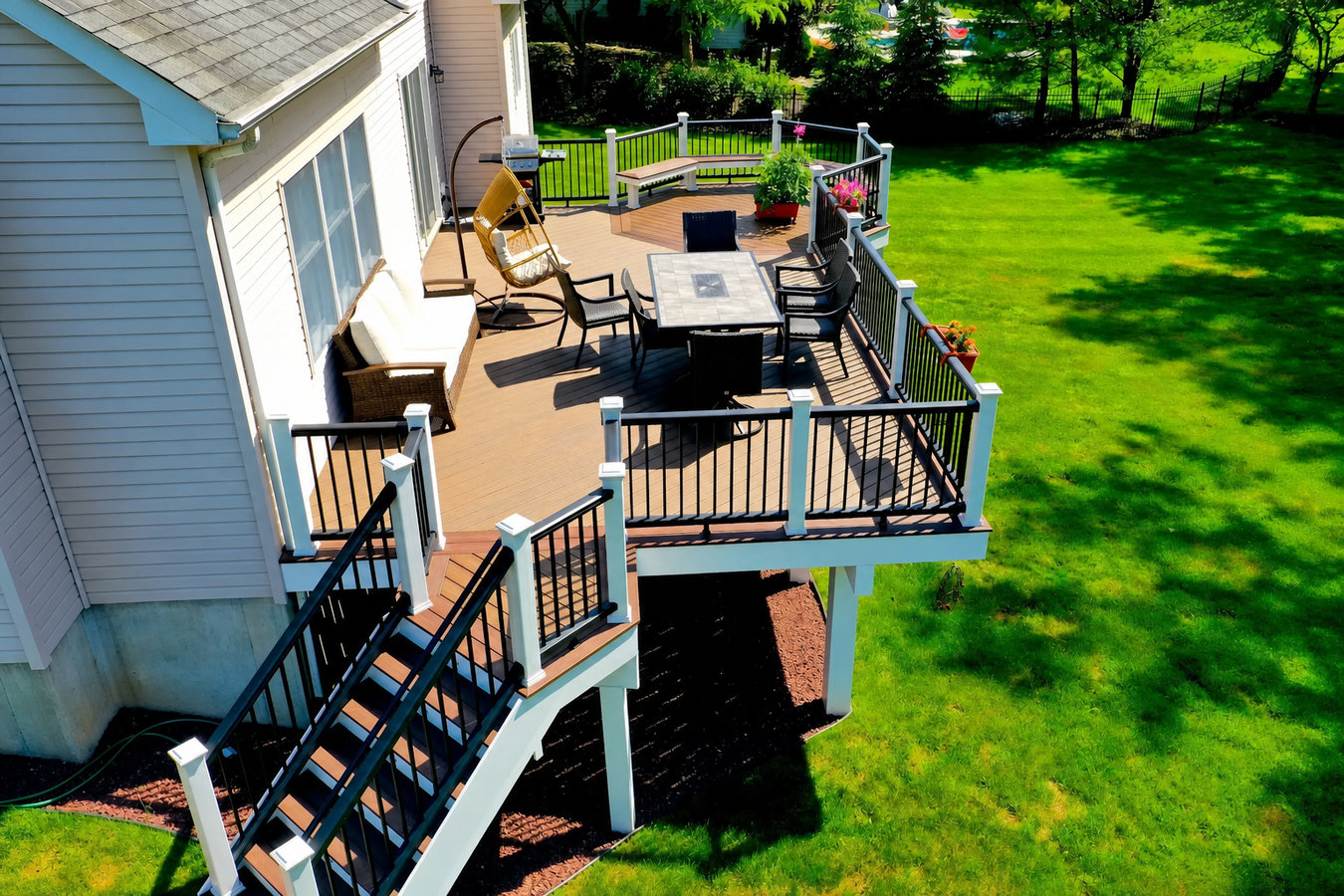
Your sloped yard or crowded single-level deck is holding you back. We build multi-level decks in Manteca that give every gathering its own space - dining on one level, relaxing on another - permitted and built right for the valley climate.
Multi-level decks in Manteca, CA are two or more connected platforms built at different heights, stepping down from your home toward the yard - most projects run one to three weeks on-site after the city permit is approved, with permit review adding one to three weeks before work begins.
Manteca homeowners with sloped lots are often the first to discover that a single flat patio just does not work with the grade of their yard. A multi-level deck solves that problem by working with the slope instead of fighting it - each platform sits at a natural height and connects to the next by built-in stairs. You end up with a yard that actually gets used, with a defined spot for grilling, a separate area for dining, and room left over for a fire pit or a future hot tub. If you are still deciding on the overall deck layout, our custom deck design and build service helps you work through the options before committing to a plan.
The permit process through the City of Manteca is something we handle on your behalf. A city inspector reviews the framing before the decking boards go down - which is actually a benefit to you, not just a formality. That inspection creates a record that protects your home value and your homeowner insurance coverage.
If your backyard drops off from your home's back door, a flat concrete patio at ground level leaves a big gap between where you step out and where you want to sit. A multi-level deck bridges that slope naturally, giving you usable space at multiple heights. If you have ever felt like your backyard is hard to use because of the grade, that is the clearest sign a multi-level design would solve the problem.
If your current deck is crowded every time you have people over - or if you are constantly moving furniture around to make room for the grill, the table, and the chairs - you have outgrown a single-level design. A multi-level deck lets you separate those functions so the cooking area, dining area, and lounging area each have their own space. You should not have to choose between grilling and having room for guests.
The intense heat in the San Joaquin Valley is hard on wood decking. If you are seeing boards that have curled up at the edges, developed deep cracks along the grain, or turned a weathered gray that no longer cleans up, the surface has reached the end of its useful life. Replacing an aging deck is also the natural time to rethink the layout and add a second level.
Heavy features like hot tubs need a dedicated, level, structurally reinforced surface - you cannot set one on a standard deck without making sure the framing underneath can carry the load. A multi-level design lets you build a reinforced lower platform specifically for that feature while keeping the upper level for everyday use. If you have been putting off adding one of these because you had nowhere to put it, a multi-level deck is often the answer.
Every multi-level deck we build starts with concrete footings dug to the right depth for Manteca's clay-heavy soil - shallow footings are one of the most common reasons decks shift and pull away from houses over time out here. The framing is engineered to handle each platform at its specific height and to carry whatever you plan to put on it, whether that is patio furniture on the upper deck or a hot tub on a reinforced lower platform. We pull the city permit and coordinate the required inspections so you do not have to navigate that on your own. Once the framing passes inspection, the decking boards, stairs, and railings go in - including code-compliant deck railing installation on any platform that sits 30 inches or more above the ground.
Material choices range from pressure-treated lumber - the most affordable framing and surface option - to composite decking boards that hold up better under intense valley sun without requiring annual sealing. For homeowners who want a fully custom layout, our custom deck design and build service works through every detail before a single board is cut. We walk you through the tradeoffs in plain language so the choice fits your budget and how you actually plan to use the yard, not just what looks good on paper.
Connected platforms that step down with your yard's natural grade - suited to homeowners whose backyard drops away from the house and needs a deck that works with the slope rather than against it.
One level for a table and chairs, one for seating and a fire pit - designed for homeowners who want dedicated zones for different activities without a larger footprint than necessary.
A reinforced lower deck engineered to carry the weight of a hot tub, outdoor kitchen island, or other heavy feature - paired with a standard upper level for everyday use.
Tear out an aging single-level deck and rebuild as a multi-level design - the most cost-effective way to get both the new structure and the added space at the same time.
Manteca sits in the San Joaquin Valley, where summer temperatures regularly climb past 100 degrees and the soil underneath most homes has a high clay content that swells in wet winters and shrinks in dry summers. That combination means two things matter more here than they would in a coastal city: the material you choose for the deck surface, and how deep the footings go. A contractor who has only worked in the Bay Area or Sacramento may not account for either. We have been building decks in this part of the valley long enough to know what holds up here and what does not. Homeowners in Lathrop and Tracy deal with the same conditions, and we serve both areas regularly.
Many of Manteca's newer subdivisions - particularly those built after 2000 on the north and east edges of town - are governed by homeowners associations with their own rules about deck size, materials, and sometimes color. If your neighborhood has an HOA, the approval process runs separately from the city permit and needs to happen before work begins. We ask about this upfront and can help you understand what your HOA typically requires so you are not caught off guard. Getting the right approvals before the first board goes down protects you from having to make expensive changes after the fact. The North American Deck and Railing Association offers resources on deck safety standards and material performance that can help you compare options if you want to do your own research before your estimate.
We ask a few basic questions - the size of your yard, whether you have an existing deck, and roughly what you are hoping to build. You do not need to have all the answers. We respond to new inquiries within one business day and can often schedule a site visit within the same week.
We come to your home, walk the yard, and take measurements. We look at the slope of the ground, where the sun hits, and how the deck will connect to your house. You get a written estimate, typically within a few days, along with a plain-language explanation of any permit or HOA factors that apply to your project.
Once you sign the contract, we submit the permit application to the City of Manteca Building Division. Plan for one to three weeks for approval - sometimes faster, sometimes a bit longer depending on the city workload. We handle all the paperwork; you should not have to do anything except be available if a question comes up.
Once the permit is approved, we dig the footings, set the posts, frame each level, and pass the city framing inspection before any decking goes down. Decking boards, stairs, and railings follow. A city inspector does a final sign-off visit, and we walk you through the finished deck, point out any maintenance steps, and hand over your permit and inspection records.
We handle the permit, the city inspection, and the soil-right footings - you just pick the design and enjoy the finished yard.
(209) 880-7645The clay-heavy soil under most Manteca homes swells in wet winters and shrinks in dry summers. We dig our footings deep enough to stay below that active zone, so the structure stays stable instead of slowly shifting out of level. That one decision is the difference between a deck that lasts 20 years and one that starts pulling away from your house after a few wet seasons.
We pull the city permit, coordinate the framing inspection, and handle the final sign-off before we consider the job done. You get copies of everything at the end. An unpermitted multi-level deck can create real problems when you sell your home - we make sure that is never a concern for our customers.
Many of Manteca's newer neighborhoods have HOA rules that run alongside the city permit process. We ask about your HOA before drawing up plans and can walk you through what the review typically requires in this area. A contractor who does not ask about your HOA is leaving you exposed to a redesign request after the work is done.
We recommend and install decking products that hold up under sustained heat above 100 degrees without cracking, fading, or warping within a few years. The California Contractors State License Board verifies that our license is active and in good standing - you can check it yourself in about two minutes on the CSLB website.
Soil-engineered footings, permitted work, and materials suited to the valley climate are not extras we add on request - they are the baseline for every multi-level deck we build. Those three things together are why our decks are still solid years after the project is done.
Code-compliant railings for every platform on your multi-level deck, installed as part of the same permitted project.
Learn MoreOne-of-a-kind layouts designed around your yard, your family, and your budget before a single board is ordered.
Learn MorePermit slots fill up fast in spring - reaching out now means your deck is ready before summer arrives. Call or send us a message for a free on-site estimate.